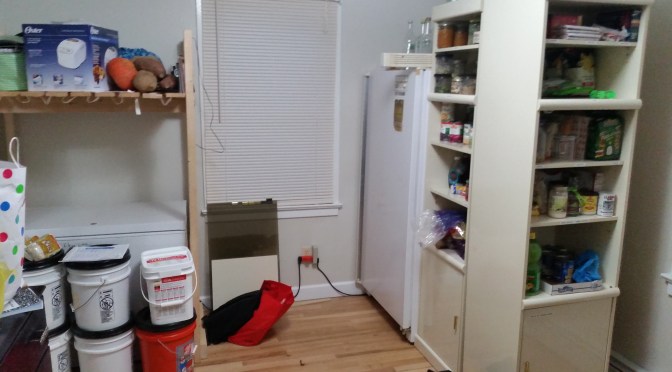
With the potential for a good snowfall this coming weekend along the northeast coast, I’m going to talk about some of the basics of food preparedness. I’m not talking about spending $3000 on a pallet of MREs or ten years of freeze dried food. I’m talking about a comprehensive, balanced, well-stocked pantry. When done from end-of-the-world paranoia, people will call you a hoarder, tin-hat conspiracy theorist, or any other number of names. But there are several very valid reasons to maintain a well stocked pantry, especially considering the average household only has three days worth of food in their house (I read somewhere but can’t find the proof). As a matter of fact, several decades ago it was considered a normal part of life for our grandparents. Anyone without a pantry was considered to be either irresponsible, or too poor off to be able to afford it, warranting charity from their neighbors to help them out.
The three easiest reasons to win someone over are economic, convenience, and resilience. There are a few basic investing principles like dollar-cost-averaging and capital deferral that make a case for storing food. Shelf stable foods, if bought in bulk when on sale, will save you money in the future if you instead had to buy it at the higher price later because you didn’t already have it. It’s very convenient and easy to have a high quality meal when you already have a large variety of prepared food in the house, instead of opening the fridge realizing there is nothing worth eating, and having to go out to eat (spending more money) because you don’t have the time to cook from scratch. There is also a very strong case for resilience and reduced stress; imagine someone in your family gets laid off (much more likely than a nuclear apocalypse, right?). Yea i know, “but that’s what unemployment is for”. Well, unemployment is a lot less than your regular paycheck, and if you were already living paycheck, to paycheck,worrying about making sure there is food on the table can be very stressful. It can lead to poor health, or making hasty decisions, like accepting the first job you can find, instead of the right job or a good paying job.
The easiest and most affordable way to begin stocking a pantry is to start a food journal. Get a piece of paper and pen and leave it in the kitchen. Everytime someone eats something, in the house or out and about, add it to the journal for that day. After a few weeks, put stars next to the things that was eaten freuently, and a double star if that thing can be easily stored (like canned tuna, a box of mac and cheese, ice cream, etc.). These are the things you eat REGULARLY and know that if you had a larger quantity of it, you would eat it all before it went bad. The next step is a simple process called copy-canning. If you can’t afford to go spend 500 dollars on food to stock up on these new-found staples for your household, instead focus on one or two items at a time. Each time you eat one can/box/etc of that item, add two cans/boxes/etc of that item to your shopping list. Repeat the process until you slowly develop a stockpile that will last you three months, then move onto another set of food items. Note, that this does not mean three months of eating nothing but mac and cheese, but rather three months worth of eating that thing at the rate you normally eat it. So if you ate mac and cheese once a week, you should copy-can your mac and cheese until you have twelve boxes(12 weeks/3 months).
The other easy opportunities to build your pantry is for bulk or opportunity buys. It is important to remember your food journal. DO NOT buy 50 cans of mushrooms because they are on super-sale if you hate mushrooms, this is akin to buying $3000 dollars worth of MREs just so you have food in an emergency, you want to eat something you like in a stressful emergency, not a can of slippery and slimy mushrooms. That being said, wholesale clubs like Costco, BJs, Sams Club, etc. are great resources for buying items in bulk that last a long time like rice and beans, or bulk packages that can go in the freezer. 5 gallon buckets with gamma lids are great resources for shelf-stable bulk items like flour, sugar, and rice. The opportunity buy are those super deals like the can-can sale at Shop Rite. I might get funny looks at the checkout, or an exasperated sigh from Lady Tinker, but buying $300 worth of soup and canned vegetables at half price just saved us $300 later this year. This food is shelf stable for one to two years, so as long as I don’t buy more than we will eat in a year, it is money well spent and money saved.
Your pantry doesn’t need to be an entire dedicated room like mine is, most people don’t have that much extra space. You can start with a spare closet, a few tupperware bins under the bed, ontop of the kitchen cabinets, or anywhere with some free space. Any little bit helps. The only other important point I will address here is to keep an organized and inventoried pantry. This includes your freezer, if you have an extra one (especially the chest freezers). You need to know what you have and where it is, or you will forget you have it it until you smell it starting to go bad.
Have I convinced you? Will you consider starting a pantry? Let me know.
 The Verdant Tinkerer